
Airport Taxi with Baby Seat, Child Seat & Booster Seat Complete UK Guide 2026

Written By awaiskhan
Updated Just Recently
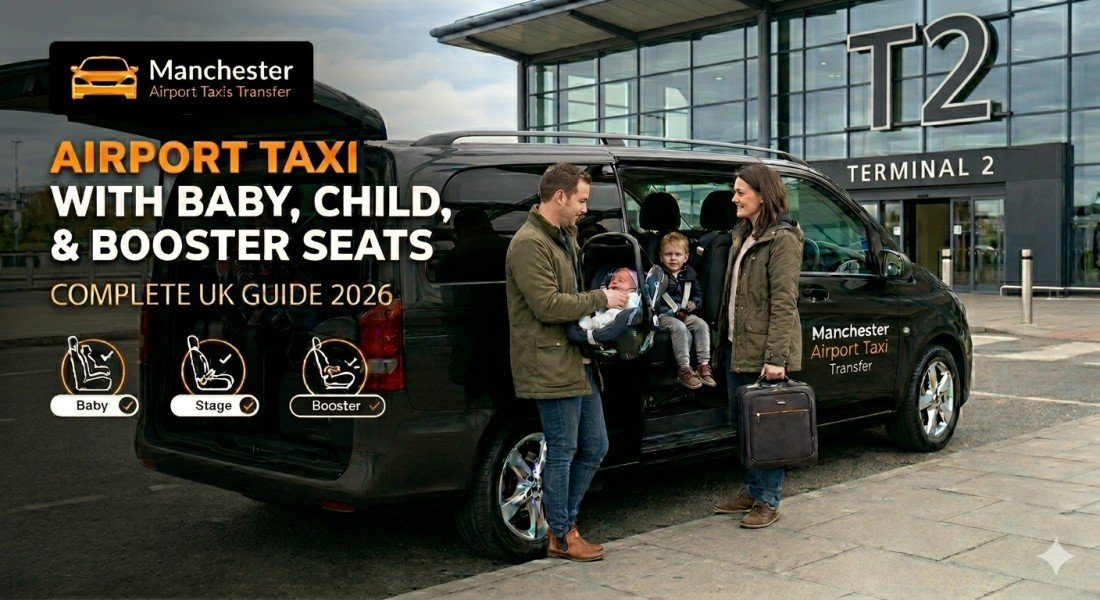
You have packed the bags. You have the passports. You have checked the flight time twice. But one question is still sitting at the back of your mind:
Does the taxi actually have the right seat for my child?
Booking an airport taxi with a baby seat or child seat is one of the most common concerns parents face and one of the least clearly answered. Most taxi websites give a vague line like “child seats available on request” and leave it there.
That is not good enough when you are travelling with a 7-month-old infant or a 2-year-old toddler at 4am on the way to the airport.
This guide covers everything UK parents need to know the right seat for every age and size, what UK law says about child seats in taxis, the difference between a baby seat, child seat and booster seat, what to ask when booking, and how to make sure your family’s airport transfer is properly arranged before the car even arrives.
What Does UK Law Say About Child Seats in Taxis?
Let us clear up the legal side first because it causes real confusion among parents.
The standard UK rule: According to GOV.UK, children must use a suitable child car seat until they are 12 years old or 135 cm tall whichever comes first. After that, they must use a standard adult seatbelt.
The taxi and private hire vehicle exemption: UK law gives licensed taxis and private hire vehicles a limited exemption. If the correct child seat is not available at the time of travel:
- Children under 3 years old may travel in the rear seat without a seatbelt
- Children aged 3 or older may travel in the rear seat using an adult seatbelt
This exemption exists because it is not realistic to expect every taxi to carry every possible seat type for every passenger.
But here is what actually matters: The legal exemption is a last resort not the standard you should accept when travelling with your child. The law sets the minimum. Good planning sets the right answer.
Always book your airport taxi with a pre-confirmed child seat: That way the exemption is never relevant because the correct seat is already in the vehicle when it arrives.
Which Seat Does My Child Need? Complete Age & Size Guide
The most common mistake parents make is choosing a seat by age alone. UK safety guidance is clear: the right seat depends on your child’s height and weight, not just how old they are.
Two children who are both 3 years old may need different seat types if one is significantly taller or heavier. Always go by size, not just birthdays.
Stage 1: Baby Seat / Infant Seat (Rear-Facing)
Age: Birth to approximately 15 months Weight: 0 to 13 kg Height: 40 cm to 85 cm
This is the correct seat for newborns and young babies. It is always rear-facing, meaning your baby travels facing the back of the vehicle, not the front.
The reason rear-facing is essential at this stage is straightforward. A baby’s head, neck and spine are still developing. In a forward collision, the most common type, a rear-facing infant seat spreads the impact across the baby’s entire back, rather than throwing their unsupported head forward.
UK safety guidance and international experts both recommend keeping babies rear-facing for as long as the seat allows ideally well beyond 15 months if the seat’s height and weight limits permit.
Key points:
- A rear-facing baby seat must never be placed in a front passenger seat with an active airbag
- The rear seat is always the safer position for infants
- When booking an airport taxi with a baby seat, always share your baby’s current weight not just their age so the correct seat is confirmed
- Always check the manufacturer’s guidance for the specific seat being used
Stage 2: Child Seat / Toddler Seat (Forward-Facing with Harness)
Age: 15 months to approximately 4 years Weight: 9 kg to 18 kg Height: 76 cm to 105 cm
Once your child outgrows the infant seat, they move into a toddler seat or forward-facing child seat. Many modern seats in this category can be used both rear-facing and forward-facing and safety experts recommend staying rear-facing until the seat’s upper weight limit is reached, typically around 18 kg.
When used forward-facing, this seat includes a built-in harness that fits over your child’s shoulders and between their legs. The harness keeps the child securely in position and distributes impact force across the strongest parts of their body.
Key points:
- A 1-year-old child may still be using an infant seat, depending on their size
- A 2-year-old will almost always need a child seat with harness
- Do not move from rear-facing to forward-facing before necessary rear-facing continues to offer better protection
- When booking an airport transfer with a child seat, share the child’s current weight, not just their age
Stage 3: Booster Seat (High-Back or Backless)
Age: Approximately 3.5 years to 12 years Weight: 15 kg to 36 kg Height: 100 cm to 135 cm
When a child outgrows the toddler seat harness, they move into a booster seat. The purpose is simple: it raises the child so that the adult seatbelt sits correctly across their shoulder and lap rather than cutting across their neck or stomach.
There are two types:
High-back booster seat: Provides support for the head and sides of the body. Better for younger children in this stage who still need head support, or for vehicles with low or no headrests. Recommended for the 3.5 to 6 year range.
Backless booster seat (booster cushion): Lighter and easier to carry. More suitable for older children who no longer need lateral head support. When using a backless booster in a taxi, the middle rear seat is often the safest position. A cushion with raised ‘horns’ helps hold the adult seatbelt correctly across the child’s body.
Key points:
- Children must use a booster seat until they are 12 years old or 135 cm tall whichever comes first
- Some taller children may reach 135 cm before their 12th birthday at that point, a standard seatbelt is appropriate
- Never use a backless booster for a child under 15 kg or younger than 3 to 4 years old
- When booking, share your child’s age and current height so the right booster type is prepared
- Always follow the manufacturer’s guidance for the specific booster being used
Quick Reference Table Right Seat for Every Age
Seat Type | Age Range | Weight | Height | Facing Direction |
Baby / Infant Seat | Birth – 15 months | 0–13 kg | 40–85 cm | Rear-facing only |
Child / Toddler Seat | 15 months – 4 years | 9–18 kg | 76–105 cm | Rear or forward-facing |
High-Back Booster Seat | 3.5 – 12 years | 15–36 kg | 100–135 cm | Forward-facing |
Backless Booster Cushion | 4 – 12 years | 15–36 kg | 100–135 cm | Forward-facing |
Should You Bring Your Own Seat or Use the Taxi's Seat?
This is one of the most practical questions parents ask and the honest answer depends on your journey.
Bring your own seat if:
- Your child is settled and comfortable in their existing seat
- You want complete certainty about the seat’s history and installation
- You are travelling with a newborn under 3 months and want full control over setup
Use the taxi’s provided seat if:
- You do not want to carry a bulky seat through the airport
- You are flying outbound and will not have your home seat available on return
- You have pre-booked and confirmed the correct seat type with the operator in advance
One option many families overlook:
If you bring your own seat on the outbound journey, ask the operator to store it safely during your trip and have it fitted and ready for your return transfer. No carrying it through the airport. No checking it in as hold luggage. No worrying whether it arrives undamaged.
Travelling with a Pram or Pushchair? Choose the Right Vehicle
A child seat takes up one full passenger seat. Add a pushchair, luggage and a changing bag and the wrong vehicle makes the whole journey uncomfortable. Use this guide to pick the right one:
Family Size | Recommended Vehicle | Passengers | Bags |
1 adult + baby + standard luggage | Economy – Skoda Octavia, Toyota Prius | 3 | 3 |
2 adults + 1 child seat + pushchair | Executive Class – Mercedes E Class, BMW 7, Audi A8 | 3 | 3 |
2 adults + 1–2 children + pushchair | MPV / SUV – VW Sharan, Ford Galaxy | 6 | 6 |
2 adults + 2–3 children + heavy luggage | Standard Van Mercedes Vito, Ford Custom | 8 | 7 |
Family group wanting premium comfort | Executive Van Mercedes V Class | 6 | 6 |
Extended family or multiple families | Minibus 12 Pax Mercedes Sprinter, Ford Transit | 12 | 12 |
Large group up to 16 with children | Minibus 16 Pax Mercedes Sprinter, Ford Transit | 16 | 16 |
When booking, tell us how many child seats you need and what you are bringing. We will match you to the right vehicle automatically.
How to Book an Airport Taxi with a Baby Seat, Child Seat or Booster Seat
Step 1: Start your booking online and enter your pickup location, destination and travel date.
Step 2: When selecting your vehicle, look for the child seat option in the booking form. Specify how many seats you need.
Step 3: In the notes or special requirements section, include:
- Each child’s age
- Each child’s current weight
- Seat type preference if you have one rear-facing infant, forward-facing toddler or booster
- Whether you are bringing your own seat
Step 4: Book at least 24 hours in advance. This allows the operator to confirm the correct seat and assign a suitable vehicle for your family before your travel day.
Why this matters: An operator who asks for your child’s weight, not just their age, is an operator who is taking child seat safety seriously. That is the level of detail that makes the difference between a seat that fits correctly and one that does not.
We Cover All Major UK Airports - Baby Seat & Child Seat Available at Every Route
No matter which UK airport you are flying from or arriving at, you can request a pre-confirmed baby seat, child seat or booster seat with your transfer. We cover all major UK airports with fixed-price, door-to-door service child seats included at no extra charge.
London Heathrow Airport (LHR)
London Gatwick Airport (LGW)
London Stansted Airport (STN)
London Luton Airport (LTN)
Manchester Airport (MAN)
Birmingham Airport (BHX)
Edinburgh Airport (EDI)
Glasgow Airport (GLA)
Liverpool John Lennon Airport (LPL)
We are based in Manchester and specialise in transfers to and from Manchester Airport (MAN) covering 120+ areas across Greater Manchester, Lancashire, Yorkshire, Cheshire and Merseyside. But our long-distance service reaches every major UK airport, so whether you are connecting through Heathrow or flying home via Gatwick, your family transfer is covered.
7 Tips for Families Travelling to the Airport with Young Children
- Always pre-book never rely on a rank taxi: A taxi picked up at the airport rank or on the street will almost never have a child seat ready. Pre-booking with written confirmation is the only way to guarantee the right setup is waiting.
- Giving specific details, not general ones like “I need a baby seat” is not enough information. Say: “My child is 10 months old, weighs 9 kg, and needs a rear-facing infant seat.” That level of detail is what gets the right seat in the right car.
- Building in extra time Getting a young child correctly secured in a car seat takes longer than buckling an adult. Add at least 10 to 15 minutes to your planned departure when travelling with a baby or toddler.
- Request meet and greet on arrival After a long flight with a tired child and multiple bags, a driver who meets you in the arrivals hall with a name board and helps with luggage makes an enormous difference.
- Go larger with the vehicle if in doubt Even if the numbers technically work in a smaller car, a larger vehicle means more boot space, more room for the child seat, and a far more comfortable journey for everyone especially on longer airport transfers.
- Do not rush the seat installation Allow the driver to carry out a proper safety check before the journey begins. A correctly fitted child seat takes two minutes to check. It is always worth the time.
- Ask about seat storage for the return journey If you are flying out with your own seat, ask the operator to store it and have it ready and fitted for your return transfer. It saves carrying it through the airport on both ends of the trip.
What to Look for When Choosing an Airport Taxi Operator for Family Travel
Not every taxi operator is set up for families with young children. When comparing options, look for these specifically:
- Child seats pre-booked and confirmed: not just “available on request” with no guarantee
- Drivers trained in child seat installation: fitting a seat correctly is a skill, not a given
- The operator asks for your child’s weight: this is the sign of genuine safety awareness
- Flexible vehicle options: saloons, MPVs and minibuses to match your family size
- Flight tracking: so your pickup adjusts automatically if your flight lands early or late
- Fixed pricing: no surge charges that penalise families travelling at peak times
- Meet and greet service: essential when travelling with babies and young children
Book Your Airport Taxi with a Pre-Confirmed Baby Seat, Child Seat or Booster Seat Today
Travelling with children does not have to be stressful. When your airport taxi with a baby seat is pre-booked, your child seat is confirmed, and your driver is already tracking your flight you can focus entirely on the journey ahead, not the logistics.
Book your airport taxi with a pre-confirmed baby seat, child seat or booster seat today.
Fixed price. Seat confirmed at booking. Flight tracking included. Meet and greet available. No surprises.
Conclusion
Planning your travel to or from a UK airport does not have to be stressful. An airport taxi transfer takes care of everything: fixed price, door-to-door service, live flight tracking, and a professional driver waiting when you land.
Whether you are flying from Manchester Airport, London Heathrow, or anywhere else across the UK pre-booking your airport taxi transfer is always the smartest move. You lock in your fare, guarantee your vehicle, and travel with complete peace of mind from start to finish.
Ready to book? Get an instant fixed quote for your Manchester Airport Taxi Transfer today no hidden fees, no surprises, just a smooth ride every time.
FAQ's
UK law gives licensed taxis and private hire vehicles a limited exemption if no seat is available, a child under 3 can travel in the rear without a seatbelt, and a child aged 3 or over can use an adult seatbelt in the rear. Safety experts strongly recommend always using the correct seat. See GOV.UK for full details. Pre-booking a taxi with a child seat removes this issue entirely.
It varies by operator. Some charge extra, some include seats free. Always confirm at booking so there are no surprises on the day.
At least 24 hours in advance for online bookings. For same-day bookings, call the operator directly to confirm seat availability.
A 2-year-old typically needs a forward-facing child seat with a harness. However, the correct seat depends on height and weight, not just age. Share your child’s current weight when booking so the right seat is confirmed.
Yes. Most operators will accommodate your own seat. Let them know at booking so the driver is prepared and can assist with correct installation.
The rear seat is always the safer position. A rear-facing baby seat must never be placed in a front seat with an active airbag.
Yes, with pre-booking. Specify your baby’s exact age and weight when booking and a rear-facing infant seat will be prepared for the journey.
A high-back booster seat provides head and side support better for younger children in the booster stage (3.5 to 6 years). A backless booster cushion is lighter and portable, suitable for older children who no longer need head support.
Yes. Specify each child’s age and weight separately at booking. The operator can prepare different seat types for the same vehicle just select a vehicle with enough space for both seats and all luggage.
When they reach 12 years old or 135 cm tall whichever comes first. After that, a standard adult seatbelt is used. See GOV.UK for current rules.
Related Articles
